Israeli aircrafts bombed targets in southern Gaza on Tuesday night in response to a rocket attack fired by Palestinian militants that hit the Israeli port city of Ashkelon, a city of 120,000 people 10 miles north of Gaza, earlier in the day.
The rockets that fired from Gaza went deeper into Israel than ever before during the offensive, leading to Israeli concerns that more foreign made rockets were being smuggled into Gaza through tunnels under the border with Egypt.
With this growing concern, Israel bombed the smuggling tunnels that connects Gaza with Egypt on Tuesday night and fired a missile at a training camp of the armed wing of the Islamist Hamas movement, which rules the enclave. Although there were no immediate reports of injuries and casualties from the Palestinian or Israeli side after both events, the possibility of peace and cooperation in Gaza is slim.
Since both sides ordered ceasefires on Jan 18 after Israel's 22-day blitz on Gaza, attacks have begun to dramatically increase since Jan. 27. Some of the attacks that have continually increased include periodic rocket and mortar shelling since the ceasefires was declared, and militants have even detonated a roadside bomb blast that killed an Israeli soldier on a Gaza border patrol. But Palestinian militants claim they were simply responding to Israeli fire.
Even though Hamas denies that it has been firing rockets and that there has been no declaration of responsibility for the rocket attack on Ashkelon, leaders in Gaza explain that the rockets were fired as a means of testing and challenging Israel, Egypt and Hamas.
Ghazi Hamad, a Hamas leader in Gaza, said Israel's decision to declare a unilateral cease-fire, without reaching agreements with Hamas, "opens the door for some factions to prove themselves at this time."
But Israeli Prime Minister Ehud Olmert, is not happy about the events that have occurred. Olmert had warned Hamas that there would be a harsh response to any further rocket fire from Gaza and vowed that the "smallest provocation would bring the harshest reaction" until the rocket fire on Israel ceased.
"We prefer, usually, to do things rather than make declarations. And when we do things, they are heard from one end of the country to the other and from one end of Gaza to the other," he said during a tour in northern Israel.
To top it off, Israeli media have suggested that any new retaliation towards Palestine could include the assassination of Hamas leaders, several of them that went to ground during the Gaza offensive and have yet to emerge.
But not all is doom and gloom for Israel and Palestine's future. Egypt has been trying with the U.S.'s approbal to create and advise a long term truce which would end Palestinian arms smuggling and also lead to reopening the coastal enclave's border crossings, one of Hamas's key demands.
A Hamas delegation planned to meet Egyptian mediators in Cairo on Tuesday to deliver a response to the truce proposals. Responding to Egypt's mediation, Hamas said on Monday it would be prepared to halt hostilities for a year if a deal could be reached on lifting Israel's crippling blockade of Gaza.
War in Gaza Far from Over?
Posted by Mona Labels: BBC refuses to Broadcast for Gaza aid, egypt, ehud olmert, hamasEvidence in Gaza proves that Israel Violates International Law
Posted by Mona Labels: BBC refuses to Broadcast for Gaza aid, Israel Palestine Conclift, Phosphorus Shells, war, War Crimes
Although the war was still occurring, it was a fairly normal day for Sabah Abu Halima and her matriarch of a farming family in northern Gaza. But that day soon turned into a nightmare when her house was hit by an Israeli shell.
Abu Halima describes what happened next as an unspeakable inferno that killed her husband and four of their nine children.
Laying at Shifa Hospital with severe burns, Abu Halima says that when her family was hit "fire came from the body of my husband and my children. The children were screaming, 'fire, fire,' and there was smoke everywhere and a horrible, suffocating smell. My 14-year-old cried out, 'I'm going to die. I want to pray.' I saw my daughter-in-law melt away."
But it’s not the scale of her loss that has caught the attention of international human rights organizations. All evidence gathered so far is leading investigators to believe that Abu Halima’s family was hit by an Israeli phosphorus shell, which violates international law and is considered a war crime.
The use of prosperous shells violates the requirement under international humanitarian law to take all feasible precautions to avoid civilian injury and loss of life."
The Israeli military spokesman said on Tuesday January, 13 that it "wishes to reiterate that it uses weapons in compliance with international law, while strictly observing that they be used in accordance with the type of combat and its characteristics." Due to mounting international pressure, on January 21, Israel finally admitted that they might have used phosphorous shells.
Amnesty International is helping to prove it. Amnesty International said it found "indisputable evidence of widespread use of white phosphorus in densely populated residential areas in Gaza City and in the north" and that streets and alleyways were “littered with evidence of the use of white phosphorus, including still burning wedges and the remnants of the shells and canisters fired by the Israeli army."
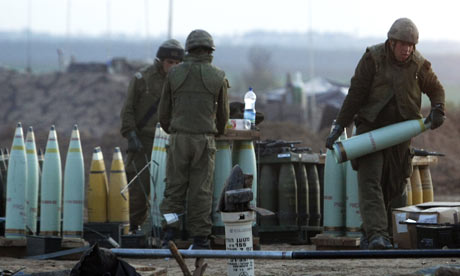
Israeli soldiers are caught on camera preparing white phosphorus 155mm artillery shells (light green) as troops keep position on the Israel-Gaza border. Photograph: Jack Guez/AFP/Getty Images
Dr. Nafez Abu Shaban, head of Shifa's burn unit, adds to Amnesty Internaional’s evidence and said the burns he treated on the Abu Halima family were one’s he had never seen before, reaching to the bone and muscle.
"They were deeper and wider than anything I had seen, a bad odor came from the wounds and smoke continued to come out of them for many hours," he said as he sat in his office around the corner from Abu Halima's sickbed.
He continued, "We took out a piece of foreign matter that a colleague identified as white phosphorus."
The phosphorus weapons used by Israel are mostly 155-millimeter shells normally used to spread a thick white smoke to screen military actions. They contain more than 100 pieces of felt soaked in phosphorus that when shot into the air can land on people and cause intense burning, according to Chris Cobb-Smith, who spent 20 years in the army and is in Gaza as part of Amnesty International's investigative team.
The phosphorus is used both to ignite and to add a whiter color when they hit the ground for better cover and to mark targets.
It added that investigation was focusing on a preserved group that fired about 20 phosphorus shells in the area where Abu Halima lived.
Tony Benn broadcasts appeal for Gaza Aid
Posted by Mona Labels: BBC refuses to Broadcast for Gaza aid, Tony BennIn response to BBC's refusal to broadcast the charity appeal for Gaza aid, Tony Benn accuses the BBC on air of giving in to the Israeli Government by refusing to air an appeal for the people of Gaza by the Disaster Emergency Commitee (DEC). He then goes on to broadcasts the Address himself much to the dismay of the interviewer.