On Monday, Israeli militants rejected accusations that its soldiers and military committed war crimes and atrocities against the Palestinians in Gaza.
Israel is claiming that most of the 1300 Palestinians killed in Gaza were “terror operatives” during “Operation Cast Lead.” "Operation Cast Lead" is also known as the Gaza operation, and was the Israel’s operation aimed to stop Palestinians from firing rockets from Gaza in to Israel.
Yet this conclusion contradicts what Israeli soldiers said earlier this month. According to an Israeli newspaper, Haaretz, numerous soldiers came forward and admitted that a lot of Palestinian civilian killings and Palestinian property was intentional.
The allegations made by Israeli soldiers in Haaretz were from soldiers that graduated from a pre-military course at an Israeli college. In them, Israeli soldiers said that they were left under the impression by Israeli troops that "inside Gaza you are allowed to do anything you want."
Israel’s top general dismisses the claims though.
"I don't believe that soldiers serving in the IDF hurt civilians in cold blood, but we shall wait for the results of the investigation," Lt. Gen. Gabi Ashkenazi said last week. Ashkenazi instead blamed Hamas for choosing to fight in heavily populated areas.
"It was a complex atmosphere that includes civilians and we took every measure possible to reduce harm of the innocent," he said, according to an IDF statement.
The conclusions made on Monday by Israeli militants follow a military police investigation that examined claims that were being made from the media and a conference. The claims said that the Israeli army intentionally damaged property and killed innocent civilians during Israel's raid into Gaza in late December and January.
Israeli military supporter General Brig. Gen. Avichai Mendelblit told the press that the stories told by the media about the war “were purposely exaggerated and made extreme, in order to make a point with the participants of the conference."
He also said that a majority of the allegations were based off of rumor and "not supported by the facts as determined by the investigation."
Yet many human rights organizations are condemning the speed that the Israeli military police reached their conclusion.
Human rights organization groups such as the Association for Civil Rights in Israel, Bimkom, B'tselem, Gisha, Hamoked, The Public Committee Against Torture, Yesh Din, Physicians for Human Rights, and Adalah have all commented on the situation.
Video About the Gaza War Crimes
"The speedy closing of the investigation immediately raises suspicions that the very opening of this investigation was merely the army's attempt to wipe its hands of all blame for illegal activity during Operation Cast Lead," nine human rights groups said in a joint statement.
These human rights groups are also calling for a civilian investigation, which Attorney General Menachem Mazuz has rejected.
"The closing of the Army's own investigation only strengthens the need for the attorney general to allow for an independent non-partisan investigative body to be established in order to look into all Israeli Army activity during Operation Cast Lead," said the organizations.
The human rights groups raise the possibility that acts by the Israeli military towards the people of Gaza are a lot worse than what has been speculated.
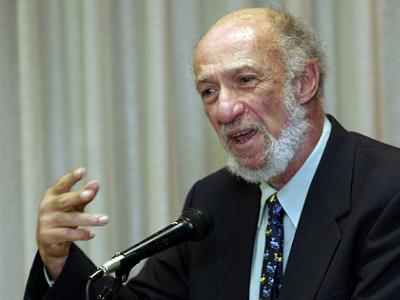
Richard Falk
In its March 1st, 2009 issue, the influential French monthly publication Le Monde Diplomatique published a very long account of the Palestinian-Israeli developments in light of the impasse caused by many respected figures in wanting to investigate and charge Israel of "potential accountability" for the 22 day blitzkrieg in the Gaza Strip.
The author is Richard Falk, a professor emeritus of international law at Princeton University whose analysis here can be regarded as one of the most intimate and complete descriptions of what has been taking place after the conflict in Gaza.
Falk ultimately argues that ever "since the establishment of Israel in 1948", today like never before, the authority is being confronted with serious and much deserved allegations of legit crimes against humanity. With that said, Falk still feels rather skeptical about the "political will" behind these allegations and concurs that it is very likely that Israel will walk away untouched.
Be that as it may, Falk's Le Monde article is quite significant not only because of its peculiar theme but also because it is one of the first post-Gaza conflict accounts of the developments and charges brought upon the Israeli authority.
The Gaza blockade is a direct violation of the fourth Geneva convention that prohibits collective punishment, says Richard Falk, the UN Special Rapporteur for the Palestinian territories.
The article deserves to be translated in many different languages seeing that the most plausible path the Palestinians can now take would have to deal with national legislation and national courts alone initiating prosecution proceedings of war crimes. Falk also notes that such legislation already exists in more than 12 countries or so, including some key EU participants.
In sight of the present crisis still harboring much of the Gaza Strip, it seems rather evident that a great deal of accountability for the horrors of what the Palestinian people endured at the will of Israeli authority was also due to the complacent attitude of the international community. Expecting the Israeli authority to initiate and indulge on the self-critical notion of prosecuting their own officials for war crimes has proven to be futile; the catchy idiom of "beating a dead horse" comes to mind.
According to UN investigator Richard Falk, Israel's refusal to allow civilians any exit route from Gaza as its military rained bombs down on schools and houses appears unprecedented in modern warfare.
We also have to bear in mind that the oppressive political atmosphere in Israel does not allow for any of this to occur. For the innocent, be they Palestinians or Israelis, the future cannot look any bleaker hence it is our collective duty as part of human society to intervene and help resolve the crisis afflicting them with complete detachment and disregard of special interests; these could be political, commercial, religious or military.
Although in comparison to these past few decades it can be argued that progress has been made, the present political climate within the international community still dramatizes the disparity between reality and the media.
In the meantime, exposing the Israeli leadership for who they are and what they have done should not be a priority of the international community - for that is well too evident to most just by analyzing the toll of the 22 day attacks on innocent Palestinians – but ultimately it should be our duty to finally sober up and at least reflect on the importance of holding the state of Israel accountable for any war crimes committed against innocent families. To avoid such an encroaching call for justice is to avoid reality.
Evidence in Gaza proves that Israel Violates International Law
Posted by Mona Labels: BBC refuses to Broadcast for Gaza aid, Israel Palestine Conclift, Phosphorus Shells, war, War Crimes
Although the war was still occurring, it was a fairly normal day for Sabah Abu Halima and her matriarch of a farming family in northern Gaza. But that day soon turned into a nightmare when her house was hit by an Israeli shell.
Abu Halima describes what happened next as an unspeakable inferno that killed her husband and four of their nine children.
Laying at Shifa Hospital with severe burns, Abu Halima says that when her family was hit "fire came from the body of my husband and my children. The children were screaming, 'fire, fire,' and there was smoke everywhere and a horrible, suffocating smell. My 14-year-old cried out, 'I'm going to die. I want to pray.' I saw my daughter-in-law melt away."
But it’s not the scale of her loss that has caught the attention of international human rights organizations. All evidence gathered so far is leading investigators to believe that Abu Halima’s family was hit by an Israeli phosphorus shell, which violates international law and is considered a war crime.
The use of prosperous shells violates the requirement under international humanitarian law to take all feasible precautions to avoid civilian injury and loss of life."
The Israeli military spokesman said on Tuesday January, 13 that it "wishes to reiterate that it uses weapons in compliance with international law, while strictly observing that they be used in accordance with the type of combat and its characteristics." Due to mounting international pressure, on January 21, Israel finally admitted that they might have used phosphorous shells.
Amnesty International is helping to prove it. Amnesty International said it found "indisputable evidence of widespread use of white phosphorus in densely populated residential areas in Gaza City and in the north" and that streets and alleyways were “littered with evidence of the use of white phosphorus, including still burning wedges and the remnants of the shells and canisters fired by the Israeli army."
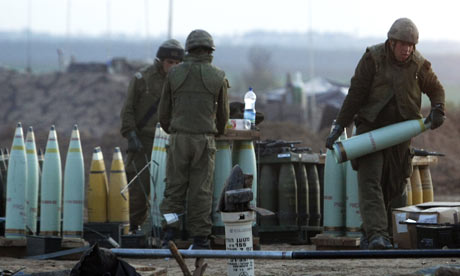
Israeli soldiers are caught on camera preparing white phosphorus 155mm artillery shells (light green) as troops keep position on the Israel-Gaza border. Photograph: Jack Guez/AFP/Getty Images
Dr. Nafez Abu Shaban, head of Shifa's burn unit, adds to Amnesty Internaional’s evidence and said the burns he treated on the Abu Halima family were one’s he had never seen before, reaching to the bone and muscle.
"They were deeper and wider than anything I had seen, a bad odor came from the wounds and smoke continued to come out of them for many hours," he said as he sat in his office around the corner from Abu Halima's sickbed.
He continued, "We took out a piece of foreign matter that a colleague identified as white phosphorus."
The phosphorus weapons used by Israel are mostly 155-millimeter shells normally used to spread a thick white smoke to screen military actions. They contain more than 100 pieces of felt soaked in phosphorus that when shot into the air can land on people and cause intense burning, according to Chris Cobb-Smith, who spent 20 years in the army and is in Gaza as part of Amnesty International's investigative team.
The phosphorus is used both to ignite and to add a whiter color when they hit the ground for better cover and to mark targets.
It added that investigation was focusing on a preserved group that fired about 20 phosphorus shells in the area where Abu Halima lived.