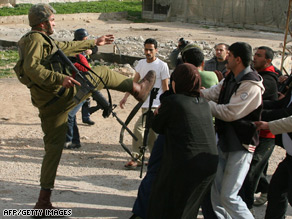
“My eyes stung, I was coughing, my nose was running,” Ben Wedeman, CNN senior correspondent in Jerusalem describes his encounter with tear gas. It wasn’t “for the first time last Friday -- during a day-long clash between Palestinian kids and Israeli soldiers in the West Bank town of Na'alin, on the West Bank,” Wedeman says.
Wedeman and his crew had gone to Na’alin, Jerusalem to monitor the Palestinian view of Tuesday's Israeli elections- which ended in a near draw.
Both front runners, Tzipi Livni and Benjamin Netanyahu, fell well short of a majority vote with Livni's party winning 28 Knesset seats and Netanyahu's party winning 27 seats out of a big 120-seat Knesset.
As they sheltered from tear gas behind a house, Na'alin resident Hani Khawaja told Wedeman, "I don't expect anything to come out of the elections that will please the Palestinians. Just killings, expulsions and land confiscations."
Out of all of the towns and villages, Wedeman chose an Na’alin because he thought it would be “the perfect place to see what Palestinians were thinking” and what he heard “was universal pessimism”.
Na'alin is an old town in the West Bank that is in the forefront of the conflict between Israelis and Palestinians. But in recent years, neighboring Israeli settlements have increasingly intruded on Na'alin's farmland, and Israel, on grounds of security, has built its security barrier around the town which creates a deep hostility between both the Israelies and Palestinians.
“I've covered almost every Israeli election since 1996,” Wedeman says, “with each election, the Palestinian feeling of despair and hopelessness only deepens.”
When talking to people in Na’alin, Wedeman says that “no one I spoke with expressed the slightest hope that any of the leading candidates --Likud's Benjamin Netanyahu, Kadima's Tzipi Livni, Israel Beitenu's Avigdor Lieberman and Labour's Ehud Barak -- would do anything to remove the settlements that are slowly closing in on Na'alin.”
But according to Wedeman, one man, Ayub Srour, had a slightly different approach. He’d rather Israeli leaders be honest about their intentions, and not raise hopes only to crush them later. He wants the Likud leader and long-time hardliner Benjamin Netanyahu to win. "At least he's honest. He says he'll expel us, and he will expel us. He says he's slaughter us, and he will slaughter us."
Since the last election in the spring of 2006, Palestinians have seen Israel and Hezbollah go to war, West Bank settlements continue to expand, Hamas and Fatah fight it out in Gaza with Hamas taking control in June 2007.
They've also seen a series of Israeli incursions into Gaza, culminating recently in the 22-day Israeli offensive that left large parts of the strip in ruins.
Meanwhile many Palestinians say their leadership, described as moderate and pro-western, in Ramallah is incapable of reversing the trend of settlement expansion.
The same leadership hasn’t been able to convince Israel to remove few of the hundreds of roadblocks and checkpoints that make travelling around the West Bank a test of patience and endurance.
When Palestinians look back over the last 15 years since the Oslo Accords were signed, they've seen their land go from bad to worse which has made many Palestinians consider a one-state solution.
The one-state solution is outrageous to many Israelis. One of Israel’s biggest concerns is that the rate of Palestinian births are so high that Palestinians could well become a majority within a generation.
Israel's current caretaker prime minister, Ehud Olmert, warned in November 2007 that if Israel doesn't move quickly to achieve a two-state solution that it will be in a similar circumstance like that of South Africa during the apartheid area where the minority, like the Israeli Jews, rule over the majority, in this case the Palestinians, by means of force, repression and discriminatory laws.
Yet many Palestinians will argue that this is already the case in Israel, citing Israeli restrictions on movement, residence, and work.
But back in Na'alin, there is some cooperation occurring. Kids are seen throwing stones at Israeli troops while Israeli soldiers shoot tear gas at them. But it’s not only young Palestinians protesting but young Israelis, self-described anarachists that take part in the protests as well.
Although cooperation between Palestinians and Israelis exists, it’s still an increasingly rare commodity. And this election probably won't do anything to bridge the growing gap between the two -- the curious friendship in Na'alin despite.
Palestinian Despair Deepens with Israeli Election
Posted by Mona Labels: Israel Palestine Conclift, israeli electionsWar in Gaza Far from Over?
Posted by Mona Labels: BBC refuses to Broadcast for Gaza aid, egypt, ehud olmert, hamas
Israeli aircrafts bombed targets in southern Gaza on Tuesday night in response to a rocket attack fired by Palestinian militants that hit the Israeli port city of Ashkelon, a city of 120,000 people 10 miles north of Gaza, earlier in the day.
The rockets that fired from Gaza went deeper into Israel than ever before during the offensive, leading to Israeli concerns that more foreign made rockets were being smuggled into Gaza through tunnels under the border with Egypt.
With this growing concern, Israel bombed the smuggling tunnels that connects Gaza with Egypt on Tuesday night and fired a missile at a training camp of the armed wing of the Islamist Hamas movement, which rules the enclave. Although there were no immediate reports of injuries and casualties from the Palestinian or Israeli side after both events, the possibility of peace and cooperation in Gaza is slim.
Since both sides ordered ceasefires on Jan 18 after Israel's 22-day blitz on Gaza, attacks have begun to dramatically increase since Jan. 27. Some of the attacks that have continually increased include periodic rocket and mortar shelling since the ceasefires was declared, and militants have even detonated a roadside bomb blast that killed an Israeli soldier on a Gaza border patrol. But Palestinian militants claim they were simply responding to Israeli fire.
Even though Hamas denies that it has been firing rockets and that there has been no declaration of responsibility for the rocket attack on Ashkelon, leaders in Gaza explain that the rockets were fired as a means of testing and challenging Israel, Egypt and Hamas.
Ghazi Hamad, a Hamas leader in Gaza, said Israel's decision to declare a unilateral cease-fire, without reaching agreements with Hamas, "opens the door for some factions to prove themselves at this time."
But Israeli Prime Minister Ehud Olmert, is not happy about the events that have occurred. Olmert had warned Hamas that there would be a harsh response to any further rocket fire from Gaza and vowed that the "smallest provocation would bring the harshest reaction" until the rocket fire on Israel ceased.
"We prefer, usually, to do things rather than make declarations. And when we do things, they are heard from one end of the country to the other and from one end of Gaza to the other," he said during a tour in northern Israel.
To top it off, Israeli media have suggested that any new retaliation towards Palestine could include the assassination of Hamas leaders, several of them that went to ground during the Gaza offensive and have yet to emerge.
But not all is doom and gloom for Israel and Palestine's future. Egypt has been trying with the U.S.'s approbal to create and advise a long term truce which would end Palestinian arms smuggling and also lead to reopening the coastal enclave's border crossings, one of Hamas's key demands.
A Hamas delegation planned to meet Egyptian mediators in Cairo on Tuesday to deliver a response to the truce proposals. Responding to Egypt's mediation, Hamas said on Monday it would be prepared to halt hostilities for a year if a deal could be reached on lifting Israel's crippling blockade of Gaza.
Evidence in Gaza proves that Israel Violates International Law
Posted by Mona Labels: BBC refuses to Broadcast for Gaza aid, Israel Palestine Conclift, Phosphorus Shells, war, War Crimes
Although the war was still occurring, it was a fairly normal day for Sabah Abu Halima and her matriarch of a farming family in northern Gaza. But that day soon turned into a nightmare when her house was hit by an Israeli shell.
Abu Halima describes what happened next as an unspeakable inferno that killed her husband and four of their nine children.
Laying at Shifa Hospital with severe burns, Abu Halima says that when her family was hit "fire came from the body of my husband and my children. The children were screaming, 'fire, fire,' and there was smoke everywhere and a horrible, suffocating smell. My 14-year-old cried out, 'I'm going to die. I want to pray.' I saw my daughter-in-law melt away."
But it’s not the scale of her loss that has caught the attention of international human rights organizations. All evidence gathered so far is leading investigators to believe that Abu Halima’s family was hit by an Israeli phosphorus shell, which violates international law and is considered a war crime.
The use of prosperous shells violates the requirement under international humanitarian law to take all feasible precautions to avoid civilian injury and loss of life."
The Israeli military spokesman said on Tuesday January, 13 that it "wishes to reiterate that it uses weapons in compliance with international law, while strictly observing that they be used in accordance with the type of combat and its characteristics." Due to mounting international pressure, on January 21, Israel finally admitted that they might have used phosphorous shells.
Amnesty International is helping to prove it. Amnesty International said it found "indisputable evidence of widespread use of white phosphorus in densely populated residential areas in Gaza City and in the north" and that streets and alleyways were “littered with evidence of the use of white phosphorus, including still burning wedges and the remnants of the shells and canisters fired by the Israeli army."
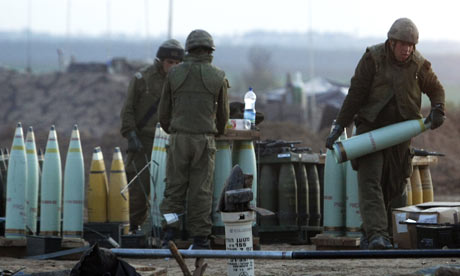
Israeli soldiers are caught on camera preparing white phosphorus 155mm artillery shells (light green) as troops keep position on the Israel-Gaza border. Photograph: Jack Guez/AFP/Getty Images
Dr. Nafez Abu Shaban, head of Shifa's burn unit, adds to Amnesty Internaional’s evidence and said the burns he treated on the Abu Halima family were one’s he had never seen before, reaching to the bone and muscle.
"They were deeper and wider than anything I had seen, a bad odor came from the wounds and smoke continued to come out of them for many hours," he said as he sat in his office around the corner from Abu Halima's sickbed.
He continued, "We took out a piece of foreign matter that a colleague identified as white phosphorus."
The phosphorus weapons used by Israel are mostly 155-millimeter shells normally used to spread a thick white smoke to screen military actions. They contain more than 100 pieces of felt soaked in phosphorus that when shot into the air can land on people and cause intense burning, according to Chris Cobb-Smith, who spent 20 years in the army and is in Gaza as part of Amnesty International's investigative team.
The phosphorus is used both to ignite and to add a whiter color when they hit the ground for better cover and to mark targets.
It added that investigation was focusing on a preserved group that fired about 20 phosphorus shells in the area where Abu Halima lived.
Tony Benn broadcasts appeal for Gaza Aid
Posted by Mona Labels: BBC refuses to Broadcast for Gaza aid, Tony BennIn response to BBC's refusal to broadcast the charity appeal for Gaza aid, Tony Benn accuses the BBC on air of giving in to the Israeli Government by refusing to air an appeal for the people of Gaza by the Disaster Emergency Commitee (DEC). He then goes on to broadcasts the Address himself much to the dismay of the interviewer.
What a lot of people don't understand is that a majority of Palestinians are not fighting for the entire state of Palestine (first map) but are fighting for the borders to return to the way it was in 1967 (third map), which is still very disproportionate considering that Palestinians are the high majority of the population.
Gaza did not become the most densely populated place on earth by chance, Palestinians were forced to crowd into the tiny strip of land by Israel which keeps expanding settlements at the expense of Palestinians.
Images to make you think - WWII in 1944 compared to Gaza, Palestine today
Posted by Mona Labels: gaza city, Israel Palestine Conclift, WW2There are many instances in human history that should never be repeated and the horrors and atrocities of World War 2 are definitively one of those events. Although I feel nobody could ever compare the lives lost and dismay from the Holocaust, I do think it is interesting to see how in over half of a century, the victims of the Nazi's have now become the perpetrators. With the problems in Gaza, it's apparent that Israel behaves toward the Palestinians as Germany did to the Jews in World War II. The pictures that will follow are striking in that they present a horific paradox between World War 2 and the conflict in Palestine, especially pertaining to Gaza (although, once again, not as immense).
The pictures on the left are from World War 2 and on the right is the comparison to the conflict in Gaza. None of these photos are mine, I received them in a mass e-mail so I wouldn't even know who to give credit to. I just felt compelled to share.


Up until the very last moment of the war, Israel vigorously drove its troops further into the destroyed Gaza City while dramatically increasing its attacks on Palestinian civilians. In just 22 days, Israeli troops took the lives of over 1300 innocent civilians in the Gaza strip, injured over 5000 people (compared to the mere 13 Israelis that were killed), and destroyed more than 22,000 buildings in the area.
The number of casualties from this war are immense, but an Israeli senior Defense Force officer claims that the attacks were never meant to be aimed at the Palestinian civilians. The attacks were “an operation of self-defense against Hamas” and that “this task was made extremely difficult by Hamas, as they made the choice to use civilians as human shields.” The Israeli officer continued to say that Israel began the offensive in response to rocket fire by Hamas militants and that the goal of the operation was “to improve the security situation in southern Israel and to facilitate peaceful living for the Israeli civilians living there.”
Although Israel is attempting to justify its attacks on Gaza civilians as “self-defense against Hamas”, it has been said that the attacks on Gaza was long planned and that Israel’s military strategy in Gaza (referred to as the “final act” by Israeli officials) followed a blueprint laid down during the Lebanon war that took place more than two years ago.
Even though both sides declared a cease fire, Palestinians in Gaza are still suffering due to the 18-month Israeli blockade that has devastated the Palestinian economy and has caused the 1.5 million Palestinians in Gaza to be completely dependent on humanitarian aid. Supplies and energy sources are running out and nearly 80 percent of crops in Gaza have been destroyed. Hospitals aren’t going to be able to handle the situation much longer. With every minute, the death toll rises along with the number of the wounded. Gaza is in desperate need of humanitarian, economic, sanitary, and social help as a result of the Israeli attacks.
Even though the attacks have been halted for the time being, Gabriel Kolko raises important questions about the war in Gaza City:
How will history describe the Israeli war against the Palestinians in Gaza? Another Holocaust, this time perpetrated by the descendants of the victims? An election ploy by ambitious Israeli politicians to win votes in the February 10 elections? A test range for new American weapons? Or an effort to lock in the new Obama Administration into an anti-Iranian position? An attempt to establish its military “credibility” after its disastrous defeat in the war with Hezbollah in Lebanon in 2006? Perhaps all of these…and more.